Monday

My Design Career

Task 4: Design Career

Post in your blog an essay of about 500 words, articulating why you would want to become a designer. Include some detail on what stimulated you to consider this career, why you have chosen to study industrial design at UNSW, and what you think your future will be like in design.

Design has always been something that has fascinated me. For a long time I always wanted to do architecture, for the simple reason that I liked technical drawing and was always interested in the way that a house was created and structured. However, I never really practiced designing and drawings houses, and would more often draw cars, which I guess is a typical boy thing to do.

For as long as I can remember I have drawn, and particularly drawn cars. It was not until about year 7-8 that I really started to follow this passion and began to become more technical in my methods. I would often draw car profiles, taking ideas from the many cars I would see in the two to three car magazines I would get a month. I had A3 books constantly being filled, and the back of my school books and diaries full of sheets with sketches on them.

In year nine I chose Technical drawing as an elective and absolutely loved it. I came first in both nine and ten for this particular subject, and remember the proud moment when I received 99/100 for an architectural assignment (but slightly frustrated that I lost one mark for forgetting to colour something in). This again rekindled the idea of doing something with technical drawing as a primary focus once I had completed my schooling. In year nine we learnt the basics of perspective drawing and at that point I began to learn how to do perspective drawings for cars. With the help of my teacher Mr Goodman, as well as the Duke of Ed program that required me to draw, I continued to work on my skills.

At this point in time I began to search for courses to pursue once I completed high school. There were many to choose from I soon discovered. Architecture again was the course I thought I would follow at any university, but I then discovered Industrial design, and realised that this would be a good fit if I wished to do car design as a career. Having seen it offered at UTS, I also found it at Monash University in Melbourne, which I thought would be fantastic as the elective in third and fourth year could relate to transportation design. However, I was not quick prepared enough in organising an application and therefore missed that opportunity.

After a few issues with my HSC, I ultimately chose UNSW as my university for a number of reasons. Firstly I achieved the entry requirements for UNSW, secondly because I did not feel very excited or feel a willingness to explore attending UTS (the thought of entering the ugly tower block would have to be enough for anyone to shy away). UNSW also accepted and considered the additional activities I completed whilst at school such as Duke of Ed and competitive swimming as part of my enrolment. Thirdly the atmosphere I experienced when visiting UNSW at the open days last year was amazing, and became very fond of the campus and the environment.

The simple reason I want to become a designer is that it allows creativity and skill to be demonstrated. There is certain excitement you get from completing a project that you don’t get from writing essays and doing hours of maths problems. You’re not limited to sitting behind a computer screen for the entire day; you can physically express yourself through your work.

And in this day and age, design is becoming a serious career, because future designers of the world will be required to understand people better and understand the impact that design has on everything. I think that for design in the future, humanity will have to take a step back in order to progress forward, that design will need to be simplified and that excess and technology be toned down a bit. It’s nice to have technology and advancements, but the fundamentals of design seem to be slipping away in the process. It’s a matter of getting back to basics.

Video Reflection - Annie Leonard


Video Blog – Annie Leonard

The story of stuff is an organisation moving towards a cleaner future by uncovering the negative aspects of consumer products in modern times. The primary focus is to discuss this idea of toxics in, toxics out. The production of consumables is having an extremely negative effect on the environment, humans and life in general. Presenter Annie Leonard has explored these issues first hand to create the following three movies:

The story of electronics

·         Bad design or “design for the dump” is this idea that products are designed with planned obsolescence so that they last for a small amount of time and the break so that newer products are bought to increase profits.
·         Much of this obsolescence centres on Moore’s law, where processors double their speed every 18 months. Therefore products are continually updated and it is very rare that a product would last particularly long or would be considered old very quickly. 
·         Humanity is facing a toxic emergency. Some new and common products are linked to cancer causing technologies. Toxins that are incorporated into design aren’t released until thrown away, which creates e-waste. Approximately 25 tons of e-water is dumped per year.
·         Companies have begun to externalising costs, meaning  to reduce the problems for companies and pass them onto the consumer
·         Take back laws and checkpoints
·         Not exporting recycling
·         Design to last

The story of cosmetics

·         Certain chemicals lead to cancers, learning disabilities, asthma and male fertility.
·         Average woman uses 12 personal care products a day, men about 6.
·         Less than 20% of chemicals have been assessed for use in products.
·         Some brands claim to help fight against use of chemicals and then use them in their products.
·         No laws against the use of toxins

The story of bottled water

·         Bottled water can be less tasty and of less quality.
·         Manufactured demand
·         Scare the consumer
·         Images of seduction
·         Most are filtered tap water

Product Sketching

Australian International Design Awards - Golden Circle Juice Bottle
Artereall Gallery - Built (Anna Carrey)
 Tait Store - Kink
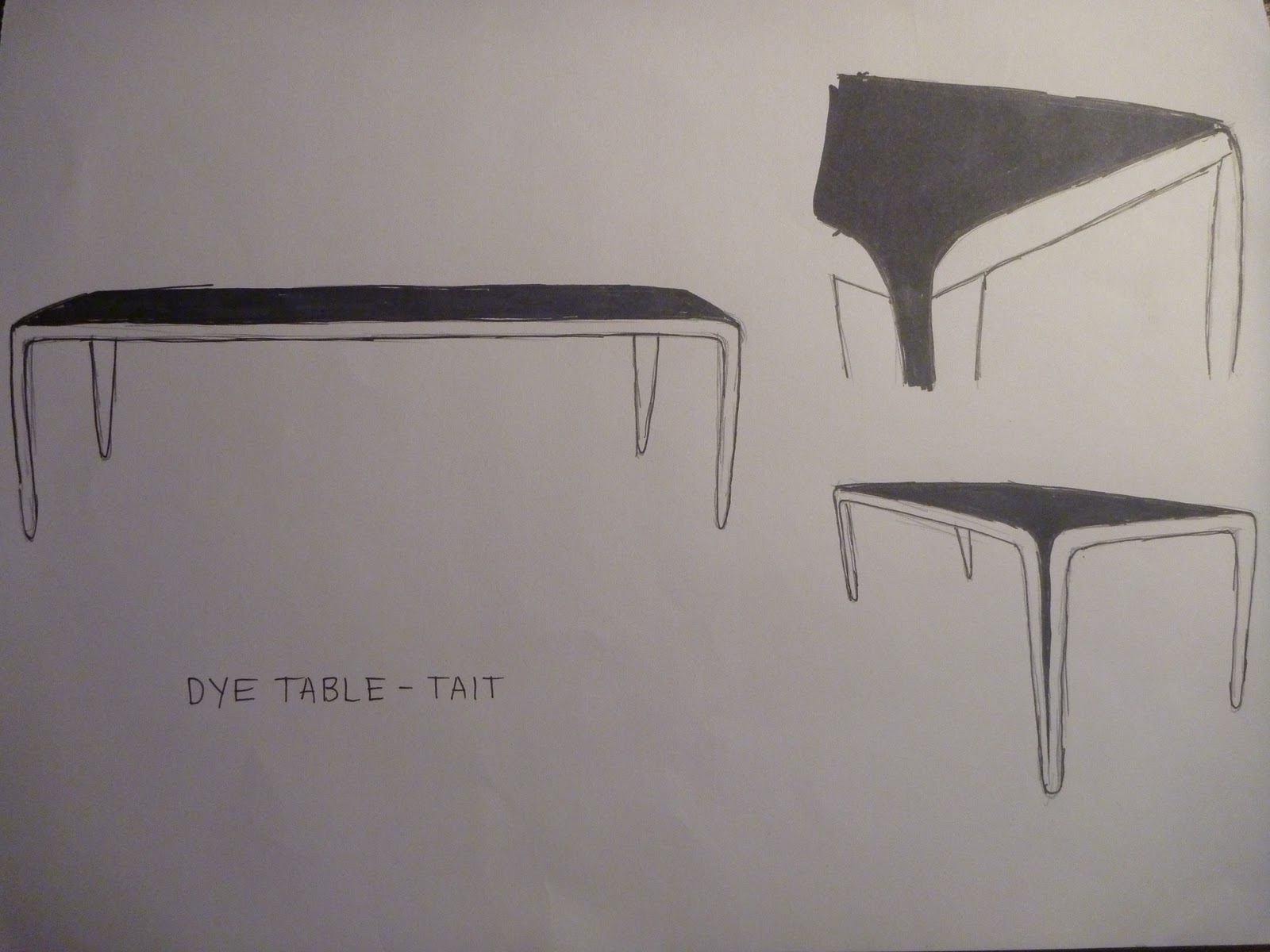
Design Precinct Surry Hills - Dye Table

Monday

Design Excellence - Sunbeam Pure Elements Grill

Video Reflections - David Kelley

Human centred design is a somewhat simple concept, but a rather complex one to successfully achieve. It is this idea that designs are created in such a way that they enhance the user experience in some form or another, with the added bonus of formulating an emotional response. For a long period of time, things were designed for the simple reason of being designed. A great focus was placed on technological products, simply to push the boundaries, but not necessarily to create an experience that was beneficial to the user. It has been in the last 20 years that this concept of human centred design has become a focus in the creation of products, with the central premise being that the resultant work has both behavioural characteristics and personality.

It became evident that 3d models and renderings were no longer an acceptable judge of human centred design. It became the norm for the products to be constructed either physically or electronically, in order to show the interaction and relationship between man and machine.

Kelley discusses a number of surprising but rather clever designs that simply focuses on human experience:

Prada New York Store – This interactive store is no longer a retail proposition but provides a cultural role. Custom technology is employed with RF tags that scan objects in order provide the consumer with information regarding the product. The LCD screen that changes the sliding door from transparent to opaque allows individuals outside to see the clothing that is being tested. The Magic mirror has an inset display with a three second delay so that the individual can see themselves from every angle, rather than straining themselves to see every view.

London Science Museum – The feature wall of the museum mimics the London Tube system, with a giant board which shows messages and comments from visitors. The messages move as a piece of light along the “tracks” and pop up as messages when they reach a “station”. This allows visitors to physically interact with the museum.  

Spyfish – This device brings the experience of scuba diving onto a boat. A camera is encased within a pod/vehicle. A cable that the device is connected too links to a user interface on board that allows you to feel what is happening underwater. Along with the video feed there is sound, which allows the user to immerse themselves within the experience. The key point is that it is not a research tool but a personal tool. 

The ides of the presentation is to convey the idea that for a design to be truly successful, it has to be designed with the user in mind. No longer can products simply be made for the sake of making, they must serve a function, and ultimately enhance the user experience.

Video Reflections - Don Norman

Don Norman: Emotional Design

The cognitive relationship between design and emotion is a fascinating topic of discussion. It is a link that is not clearly recognised or observed, for the simple reason that different people experience different reactions to different designs. Don Norman explains in simple terms the links between emotion and design, that emotions impact and influence a designer’s work, and that the emotions within a designers work inherently determine the emotions of the consumers.

His focus is on the way that happy emotions produce happy designs, and therefore happy feelings within the consumer. Norman highlights three components that ultimately shape an individual like for design. They work primarily on a subconscious basis but nonetheless impact upon human like or dislike for design. These three components are visceral design, behavioural design and reflective design. Visceral design looks at aspects of colour, shape, fonts, etc, and there impacts on shaping an individual response. Behavioural design is about being in control of what is occurring, whilst reflective design is that little voice in your head that questions thought and emotion.

Norman suggests a key concept; emotion is about communicating, it is all about acting. This is a particularly valid point. The Juicer by Philippe Starck is a product that Norman has and demonstrates as a piece of emotional design. Whilst it is totally useless as a juicer, one for functional reasons and two for the fact that the gold plating could come off when in contact with any sort of acidic liquid, its theatrics and sheer beauty make the owner smile. This stationary objects acts, communicating a strong message to an observer, that design is about being interesting, pushing the boundaries but also creating a response within an individual. For this reason it is used as a centrepiece in a room.

Another point of interest was an experiment completed with university students and two pieces of string. The simple addition of giving lollies to the students made them happy, and made it possible for them to solve the problem that was given to them. It is these tiny and somewhat insignificant differences that ultimately challenge and create successful and enticing designs.

This is a highly constructive and interesting video to view. The idea that emotion has such a vast impact upon design is fascinating, and is something that should always be considered. The simple fact that the talk is presented in a happy and enticing nature makes it worth watching. The ultimate purpose of the video is to demonstrate that a lack of passion and emotion can still produce a design, but it is those individuals that exude emotion within their designs that evoke a response, and often create something special.